Most businesses think local SEO is a review game. Get enough five-stars, keep your Google Business Profile updated, and the Map Pack will sort itself out. This thinking is why most businesses never break into the top three local results — and why their competitors who understand the real ranking architecture own the positions that drive 70 percent of local click traffic.
Local reviews matter. But they account for roughly 20 percent of what Google actually uses to determine Map Pack position. The other 80 percent is technical, structural, and almost entirely invisible to businesses running on the assumption that reputation alone drives local rankings.
This is a complete breakdown of the signals that actually control Map Pack dominance in major cities: schema geo-coordinates, branch page architecture, and citation velocity — the three levers that build genuine geographical authority in Google's local search algorithm.
Why Map Pack Rankings Are Different From Organic Rankings
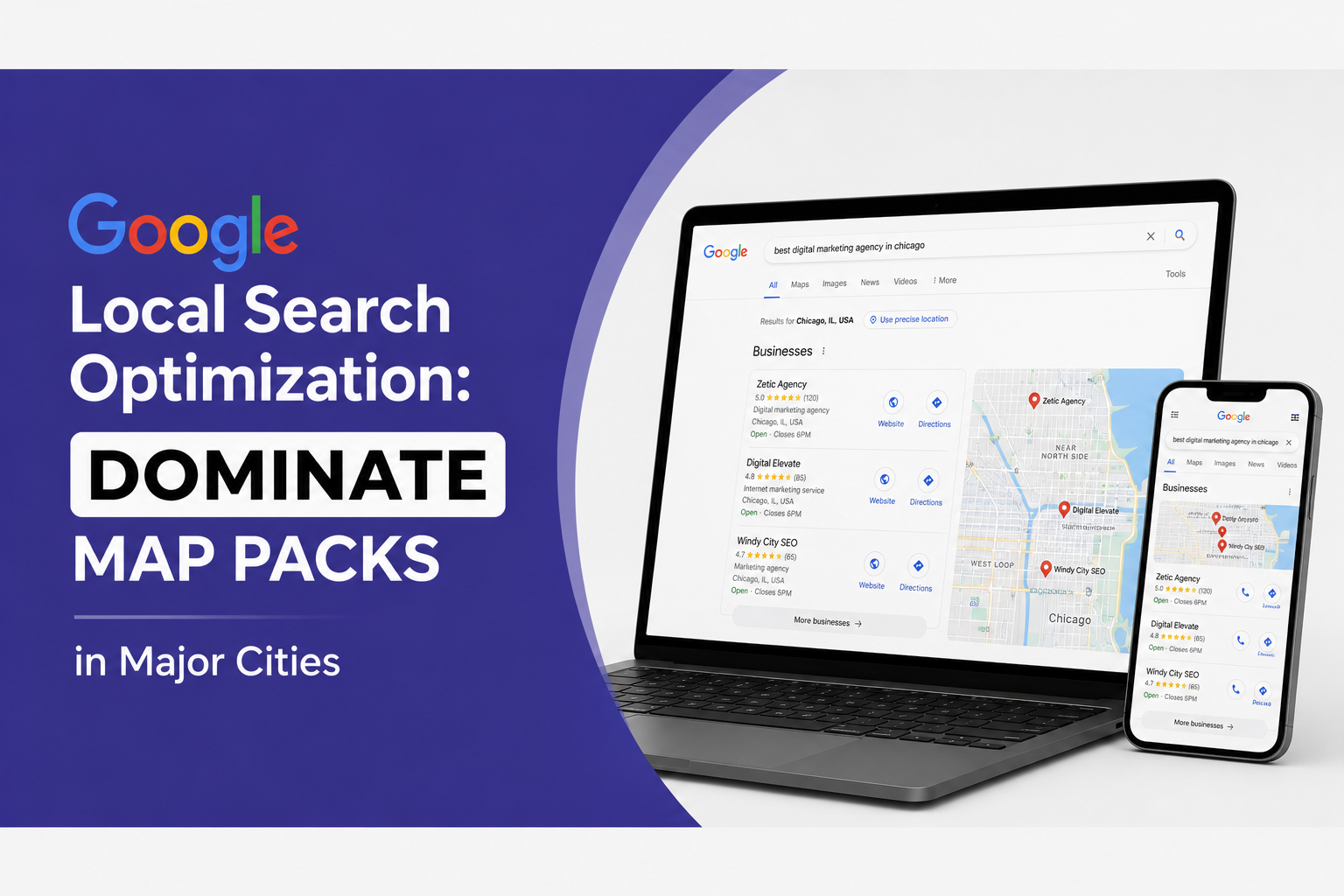
Before getting into the mechanics, it is important to understand that Google's Map Pack operates on a fundamentally different ranking system than its organic blue-link results. The Map Pack — the three-business block with map pins that appears above organic results for local queries — is powered by Google's local search algorithm, which weighs three core dimensions.
- Proximity is the distance between the searcher and the business location.
- Relevance is how well the business listing and associated content match the search query.
- Prominence is how authoritative and trusted Google perceives the business to be based on signals across the web.
Most local SEO advice focuses almost exclusively on proximity and basic relevance — update your categories, add photos, respond to reviews. These are hygiene-level optimizations. The businesses dominating competitive Map Packs in major cities are winning on prominence, and prominence is built through technical and structural signals.
The Real Review Math: Why 20% Matters and 80% Gets Ignored
Google's local ranking documentation acknowledges reviews as a prominence signal. Independent studies of Map Pack ranking factors consistently place review signals — quantity, recency, rating, and response rate — at approximately 15 to 20 percent of total ranking weight for competitive local queries.
In a tie between two equally optimized businesses, reviews often break the deadlock. But in major cities, you are not competing against businesses with equal technical optimization. You are competing against businesses that have been in the market longer, have more brand mentions, and often have legacy citation profiles that passively reinforce their geographical authority.
Outranking them with reviews alone is not a viable strategy. Outranking them by building superior technical prominence is. The remaining 80 percent of ranking weight is distributed across signals in three primary categories: on-page and structured data signals, link and citation authority signals, and behavioral signals. This guide focuses on the first two — because they are the ones you can directly engineer.
Signal One: Schema Geo-Coordinates and Structured Data
Schema markup is machine-readable metadata embedded in your website that tells Google's crawlers exactly what your business is, where it is, and what it does — without relying on Google to infer this information from page content. For local SEO, the most critical schema types are LocalBusiness and its subtypes (Restaurant, MedicalBusiness, AutoDealer, etc.), PostalAddress, GeoCoordinates, and OpeningHoursSpecification.
Schema Geo-Coordinates
Machine-readable metadata confirming precise latitude and longitude.
Branch Page Architecture
Dedicated, content-rich pages for each physical location to anchor authority.
Citation Velocity
Consistent, sustained growth of high-authority NAP mentions across the web.
Proximity & Relevance
The baseline requirements for competing in your immediate local radius.
GeoCoordinates: The Most Underused Local Schema Signal
GeoCoordinates schema allows you to embed the precise latitude and longitude of your business location directly into your structured data. This sounds redundant — Google Maps already knows where you are. But the signal value comes from the explicit confirmation between what your website asserts and what Google's own location data shows.
When your website's GeoCoordinates schema exactly matches the pin location on your Google Business Profile, which exactly matches your verified NAP (Name, Address, Phone) citations across the web, Google receives a triangulated confirmation of your precise geographical position. This reduces the ambiguity that causes ranking volatility.
The implementation inside a LocalBusiness schema block looks like this pattern:
"geo": {"@type": "GeoCoordinates","latitude": "40.748817","longitude": "-73.985428"}
Expanding Schema for Multi-Location Businesses
For businesses with multiple locations — the scenario most relevant to Map Pack competition in major cities — each location needs its own schema implementation on its own dedicated page, with unique GeoCoordinates, unique PostalAddress, and unique telephone values. Do not use a single schema block for multiple locations or allow schema to inherit values from a parent page.
- areaServed: Explicitly declare the geographic areas your business serves. Valuable for service-area businesses.
- hasMap: Link directly to your Google Maps listing from your schema markup.
- sameAs: Link to your Google Business Profile URL, Yelp, Facebook, and industry directories to consolidate authority signals.
Signal Two: Branch Page Architecture
For businesses operating across multiple locations in major cities, the single biggest organic local SEO mistake is not having dedicated, properly structured branch pages. A branch page is a unique, content-rich page on your website dedicated to a single physical location. Not a thin page with just an address and phone number.
Why Branch Pages Matter for Map Pack
Google's local algorithm needs to understand the relationship between your website and your physical locations. Without dedicated branch pages, Google has limited on-site signals to associate your domain authority with specific geographic positions. When a well-structured branch page exists, Google can:
- Crawl unique location-specific content and confirm the entity's relevance.
- Follow the relationship between the branch page and the GBP via structured data and consistent NAP.
- Weight the domain's authority toward that specific location's Map Pack result.
What a High-Authority Branch Page Requires
Every branch page must have a unique URL structure that includes the city and optionally the neighborhood or district — for example yoursite.com/locations/new-york-soho. Generic URL patterns like yoursite.com/location-12 provide no geographical signal value.
The page title and H1 must include the business type and location — not just the business name. "Hair Studio in Soho, New York" outperforms "Manhattan Hair Studio" for a Soho Map Pack result.
The page must embed the location's Google Maps iframe — not just link to it. The iframe embed creates a direct crawlable relationship between your page and the corresponding Google Maps entity. Internally, every branch page should link back to the main services pages and receive links from them in return.
Signal Three: Citation Velocity and Citation Authority
A citation is any mention of your business's Name, Address, and Phone number (NAP) on an external website. Citations are the backbone of local prominence — they are how Google triangulates the real-world existence and authority of a business across the web.
Why Citation Velocity Matters More Than Raw Count
A business that accumulates 500 citations in its first month and nothing after that sends an unnatural growth signal. A business that consistently accumulates 10 to 20 new citations per month across a 24-month period sends a signal of sustained real-world presence and operational legitimacy that Google's local algorithm rewards.
The Citation Hierarchy: Core, Industry, and Local
- Core citations: Google Business Profile, Apple Maps, Bing Places, Yelp, Facebook Business, and Foursquare. Must be fully claimed, verified, and NAP-consistent.
- Industry-specific citations: Carry disproportionate relevance weight. OpenTable for restaurants, Avvo for law firms, Healthgrades for medical.
- Local citations: City-specific directories, local news sites, chamber of commerce listings. The most underinvested tier for Map Pack dominance.
NAP Consistency: The Citation Signal That Kills Rankings When It Fails
Citation volume means nothing if your NAP data is inconsistent. Google aggregates citation signals across all sources, and when it encounters variations — different phone number formats, abbreviated versus spelled-out street names — it reduces confidence in the entity's location data and suppresses ranking.
Always use a local area code rather than a toll-free number on citations. Toll-free numbers are treated as a weak proximity signal because they do not indicate physical presence in a specific geography.
Putting It Together: The Geographical Authority Stack
Map Pack dominance in a competitive major city market is not the result of a single tactic. It is the cumulative effect of a layered technical foundation working together. Schema geo-coordinates confirm precise location. Branch pages create structural on-site signals. Citation velocity and authority build external prominence.
Reviews sit on top of this foundation as the conversion and tie-breaking layer. A business with strong technical foundations and strong reviews — that business owns the Map Pack.
The Competitive Audit: Before Any Work Begins
Before investing in any local SEO infrastructure, audit the three Map Pack winners for your target query in your target city. Ask: Does their website have dedicated branch pages? Do they have LocalBusiness schema with GeoCoordinates implemented? How many citations do they have? What is the consistency of their NAP?
In most major city markets, at least one of the three Map Pack holders has significant schema gaps, thin branch pages, or citation inconsistency. That is your entry point.
Why Zentica Agency Runs Local SEO as Technical Infrastructure
At Zentica Agency, we treat local search optimization the same way we treat paid media and engineering work: as a technical system with measurable inputs and predictable outputs, not a collection of best-practice checklists.
For businesses operating across multiple major cities, for franchise systems, for retail and hospitality brands — getting the technical local SEO infrastructure right is the difference between being findable and being dominant.
Conclusion: Map Pack Position Is an Engineering Problem
Businesses waiting for reviews to carry them to Map Pack position one are leaving the ranking architecture to chance. The 80 percent of local SEO that actually determines competitive position in major cities is technical, structural, and entirely within your control.
Ready to build a local search presence that owns Map Pack position in your target cities?
Zentica Agency delivers technical local SEO infrastructure for multi-location businesses and brands competing in major city markets. Let's build it.
Dominate Local SEO