Cookies are crumbling. Third-party data is dying. And if your Meta Ads strategy still relies on platform-native interest targeting alone, you are leaving serious money on the table — money your retainer clients are paying you to protect.
The agencies winning in 2025 are not chasing better interest stacks. They are mapping offline POS databases and CRM records directly to Meta's ad infrastructure, building custom audience pipelines so accurate they consistently double retainer ROAS. This guide breaks down exactly how to do it.
Why Meta's Default Targeting Is No Longer Enough
Meta Ads interest targeting was revolutionary when third-party cookie data was abundant. Platforms could cross-reference browsing behavior, purchase intent, and demographic signals across millions of websites to build detailed audience profiles.
That era is over.
Apple's ATT framework, Google's deprecation of third-party cookies, and increasing browser-level privacy restrictions have gutted the signal quality behind interest-based targeting. Meta's own data shows that pixel-based retargeting audiences have shrunk by as much as 30 to 60 percent for many advertisers since iOS 14.5.
The result? Bloated CPMs. Weaker lookalikes. Declining ROAS on campaigns that used to print money.
The fix is not a better interest stack. The fix is better data — specifically, your client's own first-party data.
What Are Custom CRM Audiences in Meta Ads?
Custom CRM Audiences are audiences you build inside Meta Ads Manager by uploading your client's own customer data — email addresses, phone numbers, names, zip codes — which Meta then hashes, matches against its user database, and converts into a targetable audience segment.
When done correctly, a well-built CRM audience gives you:
- Match rates of 60 to 85 percent against Meta's active user base
- Audiences built from real buyers, not behavioral proxies
- A clean seed list for high-accuracy lookalike expansion
- Full independence from third-party cookie degradation
This is the foundation of every high-performing Meta retargeting and prospecting campaign in the post-cookie era.
The Problem Most Agencies Miss: Offline POS Data Sitting Untouched
Most e-commerce brands have their CRM connected to Meta through some version of Klaviyo, HubSpot, or Shopify. That part is relatively standard.
What is almost never utilized is offline POS data.
Brick-and-mortar retailers, restaurant groups, franchise systems, and hybrid DTC brands collect enormous volumes of purchase data through point-of-sale systems — Square, Toast, Lightspeed, Clover — that never makes it into the Meta ecosystem. These are real customers, real transaction histories, real purchase frequencies, and real lifetime values sitting completely disconnected from your ad platform. Mapping that offline data to Meta Ads is one of the highest-leverage moves available in performance marketing right now, and most agencies are not doing it.
How to Map Offline POS Databases Directly to Meta Ads
Here is a practical step-by-step framework for connecting offline POS data to Meta's custom audience infrastructure.
Step 1 — Export and Clean Your POS Data
Pull a full customer export from your client's POS system. You need at minimum: email address, phone number, first name, last name, and zip code. Clean the data — remove duplicates, standardize phone formatting (+1XXXXXXXXXX), and lowercase emails.
Step 2 — Segment by Purchase Behavior
Do not upload a raw undifferentiated list. Build separate lists for: recent purchasers (30 days), frequent buyers (2+ in 90 days), high-LTV customers, and lapsed customers (180+ days).
Step 3 — Upload via Meta's Customer List
Navigate to Audiences > Create Audience > Customer List. Upload your segmented CSV. Meta hashes all identifiers client-side before matching. The more columns you map, the better the match rate.
Step 4 — Use Offline Conversions API
For ongoing campaigns, set up Meta's Conversions API (CAPI) with your client's CRM/POS to push offline purchase events directly to Meta in near real-time, keeping audiences fresh.
Step 5 — Build Your Lookalike Pipeline
Create 1%, 2%, and 3% lookalikes from your high-LTV and repeat-buyer segments. These lookalikes are built from your best real customers, not behavioral proxies.
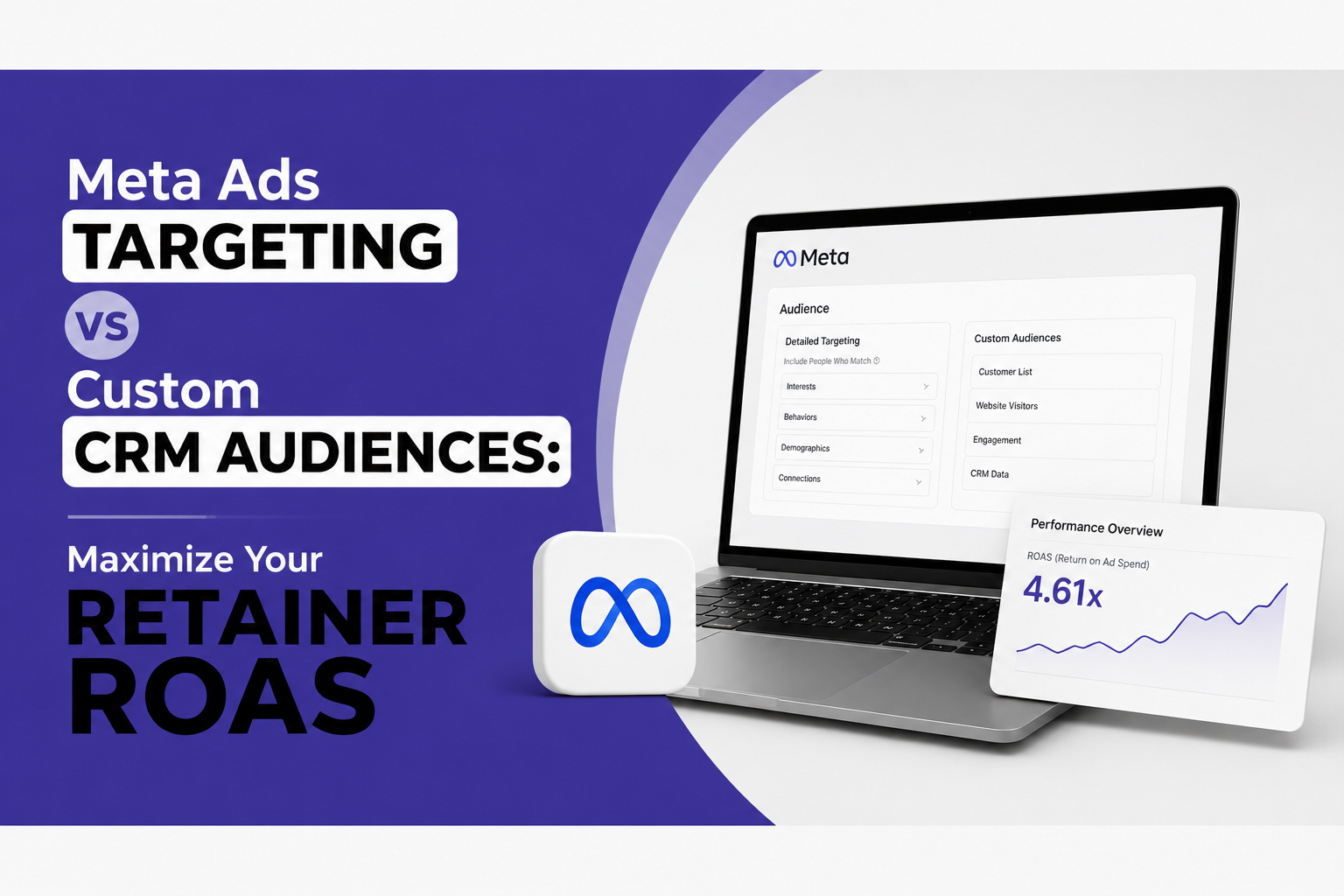
Direct Comparison: Meta Ads Targeting vs Custom CRM Audiences
Accuracy
Meta interest targeting relies on behavioral inference. Custom CRM audiences are built from verified real customer identities.
Retargeting Precision
Interest targeting can only approximate audiences. CRM audiences retarget real buyers with surgical precision.
Lookalike Quality
Lookalikes seeded from your best CRM customers are exponentially cleaner and more predictive than interest-based seeds.
Cookie Dependency
Interest targeting degrades without cookies. CRM audiences are entirely first-party and immune to restrictions.
ROAS Impact
CRM-seeded audiences routinely produce 1.8x to 3x higher ROAS than equivalent interest-targeted campaigns.
Real-World Impact: What This Looks Like at the Retainer Level
Consider a mid-sized retail client with 40,000 customer records in their POS system and a $15,000 monthly Meta Ads retainer budget. Before implementing CRM audience mapping, their campaigns ran on interest stacks and pixel-based retargeting. Average ROAS across the account sat at 2.4x.
After segmenting the POS database, uploading tiered customer lists, connecting the Conversions API for ongoing sync, and rebuilding their prospecting campaigns on POS-seeded 1% lookalikes, their account ROAS moved to 5.1x within 60 days — on the same budget.
"That is not a small optimization. That is the difference between a client who questions the retainer and a client who expands it."
Common Mistakes That Kill CRM Audience Performance
- 1Uploading dirty data with mismatched formats or missing fields.
- 2Skipping segmentation and uploading a single undifferentiated list.
- 3Neglecting audience refresh cycles, leading to stale customer lists.
- 4Ignoring exclusions and overlapping current customers with prospecting campaigns.
Why This Matters for Agency Retainer Retention
ROAS is the number your clients watch. When ROAS goes up, retainers renew. When ROAS stagnates, clients shop for new agencies.
CRM audience mapping is one of the clearest paths to sustained ROAS improvement available in Meta advertising today. It requires a one-time data infrastructure setup, ongoing maintenance discipline, and the strategic knowledge to segment and seed correctly — all of which are billable competencies that deepen client dependency on your agency's expertise.
This is not just a campaign tactic. It is a retainer defense strategy.
Conclusion: The Agencies That Win Use Their Clients' Own Data
The performance gap between agencies running default Meta interest targeting and agencies running CRM-seeded custom audience pipelines is only going to widen as the cookie ecosystem continues to erode.
Mapping offline POS databases to Meta's ad infrastructure, building segmented custom audiences from real purchase data, and creating lookalike pipelines seeded from verified high-LTV customers is the most reliable way to double retainer ROAS in the current landscape. Your clients' data is their most valuable media asset. The agencies that know how to activate it will own the next decade of paid social performance.
Ready to build a CRM audience pipeline that actually moves ROAS?
Zentica Agency specializes in first-party data strategy for Meta Ads retainer clients.
Let's Talk Strategy